
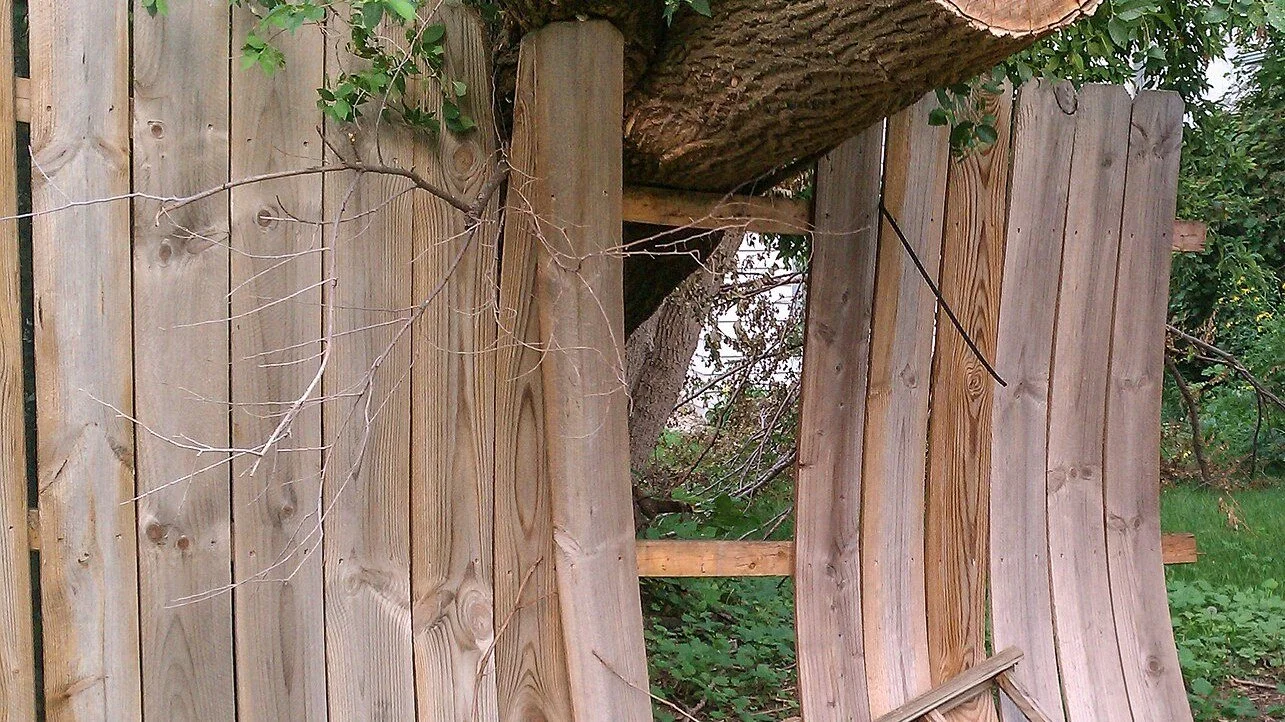
Photo: Tony Webster, CC BY 2.0 (cropped)
A strong wind night can leave a fence leaning, cracked, or flat on the lawn. Here's what to do first, how to tell if it can be repaired, and what to know about insurance and your neighbor.
1. Safety first
Stay at least 100 feet away, keep kids and pets back, and call 911. If something is caught in a line, call your electric company (SCE: 1-800-611-1911; parts of south Orange County are served by SDG&E). Don't try to move the fence yourself.
- Wear gloves and closed shoes. Broken boards and panels have nails, screws, and sharp edges.
- If a section is leaning, lay it down flat instead of leaving it hanging. Another gust can finish knocking it over.
- If the fence was part of your pool's barrier, keep kids and pets away from the pool until it's closed off again.
- Check that dogs can't get out through the gap.
2. Take photos before you move anything
Take wide photos of the whole fence and close-ups of the broken posts, the base of each post, and any damage to your house, car, or your neighbor's yard. You may need them for insurance or to show your neighbor what happened.
3. Repair or replace? Look at the posts
The boards and panels are what you see fall, but the posts tell you what really happened.
- Boards or panels blew off, but the posts are still standing straight and solid
- Vinyl panels popped out of the posts without cracking
- One post broke from a falling branch
- Several posts snapped at the ground
- The wood at the base of the posts is soft or rotten
- The posts wobble when you push on them, or came out of the ground with little or no concrete
Quick check: push on each post near the top. A good post barely moves. Then press a screwdriver into a wood post right at ground level. If it sinks in easily, the post is rotting, and a repair on top of it will probably fall in the next windstorm.
Solid privacy fences catch the wind like a sail, so weak posts show up first on those. That's why one bad stretch often goes down while the rest stays up.
4. Call your insurance company before you decide
Many homeowners policies cover fences under "other structures" coverage, which is usually a share of your home's coverage (often 10%). Ask your insurance company:
- Is wind damage to my fence covered?
- What is my deductible? If the repair costs less than the deductible, a claim may not make sense.
- Do you need an estimate from a contractor, and do you want to inspect it first?
5. If the fence is shared with a neighbor
In California, neighbors are presumed to share the reasonable cost of a fence on the property line equally (Civil Code §841). Before spending money on it, the law asks you to give your neighbor written notice at least 30 days ahead, explaining the problem, the fix, the estimated cost, how you propose to split it, and the timeline.
Most of the time a friendly conversation and a short note are enough. If the damage leaves your yard open, talk to your neighbor about a temporary fix while you work out the rest. For more, see our guide to fences and property lines.
6. Before the next windstorm
- Walk your fence once a year and do the push test on every post.
- Fix loose boards and leaning posts early. Small problems are what the wind finds.
- Keep plants, soil, and sprinklers from keeping the base of wood posts wet.
- Trim branches that hang over the fence.
If you'd like a second opinion on repair or replace, we're happy to come take a look: contact us.